

A Parent's Guide to Tech Careers
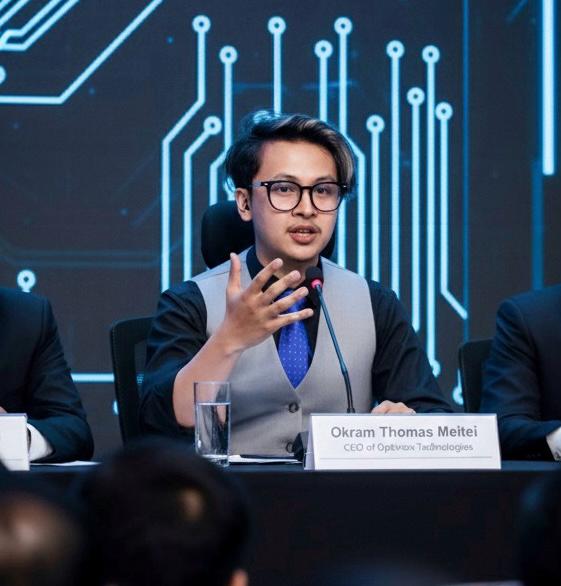
Okram Thomas Meitei
Director & Lead Instructor · 28 April 2026 · 8 min read
If your son or daughter has been talking about doing a tech course or switching careers into software, you are probably the one who has to ultimately weigh in on whether it makes sense — financially, practically, and in terms of their future. I want to speak to you directly, without jargon, and without trying to sell you anything.
I run a tech academy in Imphal called Optivoxx. I've had many conversations with parents over the past few years — some who came in supporting their child's interest, some who came in skeptical, and some who came in without understanding what tech work actually involves. I want to give you what I give them: a clear, honest picture.
What a tech career actually is
'Tech' covers a wide range of real work. At one end are roles that involve writing software — building applications, websites, and data systems that other people use. At the other end are roles in data analysis, cybersecurity, cloud infrastructure, project management, and technical operations. The common thread is that these jobs are done primarily on a computer, often remotely, and the core skills travel across industries and geography.
A software developer writes the code that runs the applications on your phone, the banking systems you use, and the platforms your children interact with daily. A data analyst uses programming tools to find patterns in large amounts of information that help companies make decisions. A cloud engineer manages the infrastructure that keeps company systems running without interruption. These are not abstract or theoretical jobs — they are roles with specific daily work, real output, and real accountability.
The important thing for a parent to understand: these jobs are not geography-dependent in the way that most careers are. A skilled developer in Imphal can work for a company in Bangalore, Hyderabad, or increasingly for companies outside India, without relocating. The work travels through the internet.
The earnings picture — honest, not inflated
I want to give you real numbers rather than the inflated figures that appear in tech education marketing.
Entry-level tech roles in India currently start between Rs 3-7 LPA, depending on the specific role, the quality of the candidate's preparation, and what they can demonstrate. Full-stack developer positions entry-level range from Rs 4-7 LPA based on Glassdoor India data. Cloud and DevOps roles start at a similar range. Data science and AI roles, which face acute skill shortages, tend to start higher than general development roles.
These numbers improve significantly with two to four years of consistent, demonstrable experience. A developer who builds real systems and grows their skills over a few years moves into a meaningfully different salary band. This is a career with genuine earning growth over time — not a fixed rate.
What I would caution against is dismissing the starting numbers as insufficient, or inflating expectations by citing only the highest possible tech packages from headline stories. Both extremes misrepresent what a realistic first year looks like. A candidate who has prepared properly and can demonstrate real work is well-positioned to enter at the mid-to-upper end of the entry range. A candidate who completed a course but cannot demonstrate independent work will struggle regardless of what any academy's marketing claims.
Why a degree alone is not sufficient
This is the conversation I have most often with parents, and I try to be respectful but direct. In the tech industry, a degree is not a sufficient signal of competence on its own. This is meaningfully different from law, medicine, or government services — fields where the credential is the gate. In tech, employers want to see what your child has actually built.
This does not mean a degree is worthless. A computer science or engineering degree builds valuable foundational knowledge that matters for certain kinds of technical work. But I see graduates every year who finished three or four years of college without being able to write working software on their own, because their programme focused on theoretical examinations without requiring real project work.
What employers actually look at when they are hiring: a portfolio of real projects, evidence of practical problem-solving, and the ability to reason about technical problems in a conversation. A student who has these things — whether they developed them through a degree, a structured academy, or both — has a clear path to employment. A student who only has a degree and no demonstrated work does not, in the current market.
The degree proves your child spent time studying. The portfolio proves they can do the work.
What structured training actually provides
The difference between a student who learns on their own and one who learns in a structured environment with experienced instruction is not primarily about intelligence. It is about the feedback loop.
Self-learning is possible — many good developers are largely self-taught. But the typical self-learner spends days stuck on problems that an instructor would resolve in twenty minutes. They follow tutorials without understanding how to connect the pieces to a real application. They don't know what a professional development environment actually looks like until they're already trying to get their first job and realising they've missed things.
Structured training, at its best, provides:
- A clear progression from fundamentals to real projects, not a random collection of tutorials
- Instructors who can identify exactly where a student's understanding breaks down — not just that something doesn't work, but why
- Peers who provide accountability and the kind of learning that comes from working alongside people at the same stage
- Real project work that becomes the student's portfolio — tangible, demonstrable output
- An honest view of what the actual job market expects, from someone who knows the market
At Optivoxx, we run live classes, build through real projects, and provide placement support. This is mentored learning with accountability built in, not a recorded course library. I teach the classes myself.
Questions worth asking before investing in any programme
Before your family commits money or time to any tech training, here are the questions I would encourage you to ask — of any academy, including mine:
- What will my child actually build during this programme, and can I see examples of what past students have created?
- Who teaches the classes, and how current is their practical industry experience?
- What does placement support look like specifically — not 'we have industry connections,' but what does that mean in practice?
- Is this primarily live instruction or recorded content? There is a meaningful difference.
- What is the refund or exit policy if the programme does not deliver what it promises?
These are fair questions. You are making a real investment in your child's future. You deserve specific answers, not reassuring vagueness.
How to support your child's journey
The students I see succeed are almost always the ones whose families understood what they were doing and supported it actively. That support doesn't require technical knowledge — it requires taking the career seriously.
What I consistently see matter:
- Understanding that the first three to six months are the hardest, and not pushing your child to stop when progress feels slow — this stage has a specific difficulty curve that almost everyone goes through
- Providing a consistent, quiet space with reliable internet access — tech learning requires uninterrupted time in a way that's easy to underestimate
- Treating this as a real career path, with the same seriousness you would give to medicine or engineering — not a fallback or a hobby
- Asking them to show you what they are building, even if you don't understand the technical details — the act of explaining it to a non-technical person builds real understanding
- Connecting them with people working in tech if you know any — mentorship and professional network are rare and genuinely valuable, and even one good introduction can change an outcome
A direct word about the opportunity
If your child is genuinely interested in this field and willing to put in the work, the opportunity is real. Software and technology careers are among the very few where geography, family background, and the prestige of your undergraduate institution matter significantly less than what you can actually demonstrate. That is not true of most professions.
I started Optivoxx because I believe the young people of Manipur are as capable as tech talent anywhere in the world. They've just not always had the door opened for them. This is my attempt to open it.
If you want to speak directly — or bring your child in for a free counselling call — we welcome that. It is a real conversation, not a sales presentation. Come with your questions.
Sources
Okram Thomas Meitei
Director & Lead Instructor
I started Optivoxx with one conviction: the young people of Manipur are every bit as capable as talent anywhere in the world — they've just never had the door opened for them.